Loading...
Cyclone Damage Restoration
24/7Emergency Response
Cat 1–5Cyclone Experience
InsuranceApproved & Supported
NorthernAustralia Coverage
Emergency Cyclone Response
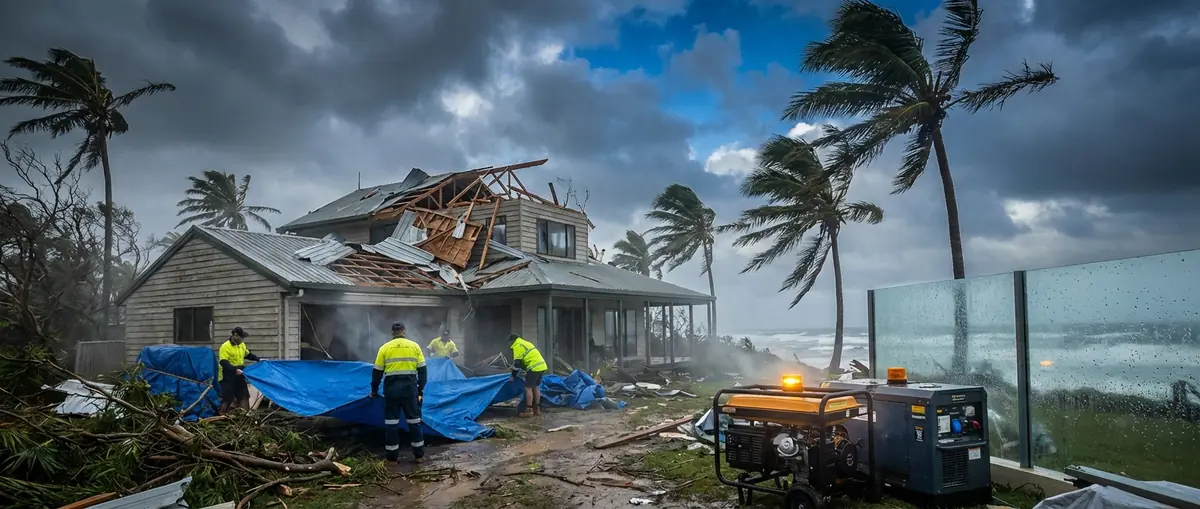
When a tropical cyclone passes through, the aftermath can be devastating — from total roof loss and structural collapse to widespread flooding and debris fields stretching for kilometres. Disaster Recovery connects you with IICRC-certified contractors who deploy emergency make-safe crews across northern Australia as soon as authorities declare the area safe for re-entry.
What to do immediately after a cyclone:
- Stay inside until authorities confirm the cyclone has passed and the area is safe — the eye of the cyclone is not a safe period
- Do not re-enter damaged buildings until a structural assessment has been completed
- Stay well clear of downed power lines, damaged trees, floodwater and debris
- Photograph all visible damage from a safe distance before any cleanup begins
- Beware of displaced wildlife — snakes and other animals are commonly displaced by cyclone events
- Start your claim online — our platform lodges your details and dispatches the nearest available IICRC-certified contractor for emergency make-safe work
Pre-positioning: During cyclone season (November to April), our contractor network pre-positions equipment and crews in cyclone-prone regions. This includes industrial pumps, temporary roofing materials, structural bracing and commercial drying equipment — enabling rapid deployment the moment conditions allow safe access.
Types of Cyclone Damage
Tropical cyclones deliver a combination of destructive forces — extreme wind, storm surge, torrential rainfall and airborne debris. A single cyclone event can inflict multiple types of damage simultaneously, each requiring specialist restoration techniques.
Extreme Wind Damage
Lifted and lost roof sheeting, blown-off ridge caps, collapsed carports and pergolas, damaged wall cladding, shattered windows and displaced fencing from sustained winds exceeding 200 km/h in severe events.
Storm Surge Flooding
Coastal inundation driven by cyclone-generated storm surge — saltwater flooding that penetrates inland, contaminating properties with Category 3 black water containing sand, debris, sewage and marine contaminants.
Debris Impact
Airborne debris — roofing iron, tree limbs, fencing, signage and building materials — propelled at destructive speeds, penetrating walls, smashing windows and causing structural puncture damage across wide areas.
Roof Loss
Partial or complete roof loss where wind forces exceed the structural capacity of roofing connections. Exposes the entire interior to rainfall, causing catastrophic water damage to ceilings, walls, flooring and contents.
Structural Failure
Collapse or severe compromise of load-bearing walls, roof trusses, support columns and foundations. In Category 4 and 5 events, entire buildings can be reduced to slabs, requiring complete demolition and rebuild.
Water Ingress
Wind-driven rain forced through damaged roofing, broken windows, failed seals and compromised wall cladding — saturating internal linings, insulation and flooring and creating ideal conditions for rapid mould growth.
Australian Cyclone Category Guide
The Australian Bureau of Meteorology classifies tropical cyclones on a 1 to 5 severity scale based on maximum sustained wind speed and gust intensity. Understanding the category helps property owners anticipate the likely extent of damage and the restoration response required.
Category 1— Gusts 63–88 km/h
Minor damage to gardens, trees and caravans. Minimal structural impact to well-maintained buildings. May cause minor roof damage to poorly secured sheeting and dislodge loose items. Restoration typically involves minor repairs, debris cleanup and tree removal.
Category 2— Gusts 89–124 km/h
Significant damage to roofing, windows and vegetation. Caravans may be destroyed and poorly constructed buildings suffer structural damage. Power outages likely. Restoration includes roof repairs, window replacement, water ingress drying and debris clearance.
Category 3 — Severe— Gusts 125–164 km/h
Roof sheeting blown off, structural damage to walls, power failures across wide areas and dangerous airborne debris. Some buildings experience partial roof loss. Restoration involves emergency tarping, significant roof replacement, structural repairs, water extraction and comprehensive drying programs.
Category 4— Gusts 165–224 km/h
Significant structural damage including complete roof loss on some buildings, airborne debris causing widespread damage, exterior wall failure and large-scale flooding. Restoration is major — structural engineering assessment, temporary roofing and bracing, extensive water damage remediation and potentially partial rebuild.
Category 5 — Extreme— Gusts over 225 km/h
The most extreme destruction — complete roof loss, collapse of walls and entire structures, widespread devastation across communities. Examples include Cyclone Tracy (Darwin, 1974), Cyclone Larry (Innisfail, 2006) and Cyclone Yasi (Mission Beach, 2011). Restoration ranges from major structural rebuild to complete demolition and new construction, often taking 6 to 12 months or longer.
Our Cyclone Restoration Process
From the moment conditions allow safe access through to final sign-off, our five-stage process ensures your property is stabilised, documented and fully restored — with your insurance claim supported at every step.
1. Safety Assessment
A qualified contractor inspects the property to determine if it is safe to enter. Structural integrity, electrical hazards, asbestos risk and flood contamination are all assessed before any work begins. Engineers are engaged for severe structural damage.
2. Emergency Make-Safe
Temporary roofing installation, structural bracing to prevent further collapse, board-up of broken windows and openings, hazardous debris removal and isolation of damaged electrical and gas services. Priority is preventing further damage.
3. Water Extraction & Drying
Submersible pumps remove standing flood water. Industrial dehumidifiers and air movers are deployed for structural drying. Contaminated water from storm surge is treated with antimicrobial agents. Daily moisture readings track progress to pre-loss levels.
4. Structural Repair
Roof replacement or restoration, wall and framing repairs, window and door replacement, and foundation stabilisation — all completed to current Australian Building Code standards for cyclone-rated construction (Wind Region C and D).
5. Full Restoration
Internal fit-out including plastering, painting, flooring, cabinetry and electrical and plumbing reinstatement. Your property is returned to pre-cyclone condition — or better, with cyclone-rated upgrades where required by current building codes.
Cyclone Insurance Claims
After a major cyclone, insurers receive thousands of claims simultaneously. Properties with thorough, professional documentation are processed faster and with fewer disputes. Disaster Recovery connects you with experienced, IICRC-certified contractors who know exactly what insurers require for cyclone damage claims.
How we support your cyclone damage claim:
- Drone assessment — high-resolution aerial photography of roof and structural damage without requiring unsafe ladder access on compromised buildings
- Comprehensive documentation — every aspect of damage is photographed, measured and recorded using moisture meters, thermal imaging and professional reporting systems
- Detailed scope of works — a line-by-line breakdown of all required repairs, materials and labour prepared in the format your insurer expects
- Emergency make-safe invoicing — temporary repair costs documented separately for immediate reimbursement under your policy's emergency provisions
- Comprehensive claims documentation — IICRC-certified contractors prepare detailed documentation, photos, and reports — everything you need to support your insurance reimbursement claim
- Progress reporting — photographic evidence at every milestone throughout the restoration, satisfying insurer requirements for staged approvals and payments
Most comprehensive Australian home and commercial insurance policies cover cyclone damage including wind damage, roof loss, debris impact and water ingress. Storm surge flooding may be covered under the flood component of your policy. Check your Product Disclosure Statement or contact your insurer for specific coverage details.
Equipment & Technology
IICRC-certified contractors in the Disaster Recovery network deploy specialised equipment designed for the unique challenges of cyclone damage restoration — from large-scale water extraction to structural stabilisation and comprehensive documentation.
Industrial Pumps & Extraction
High-capacity submersible and trash pumps capable of extracting thousands of litres per hour, including debris-laden Category 3 flood water from storm surge inundation. Truck-mounted extractors for large-scale commercial properties.
Commercial Drying Systems
LGR and desiccant dehumidifiers, high-velocity air movers and axial fans engineered for tropical humidity levels. Injectidry cavity drying systems reach moisture trapped behind walls and under floors where conventional equipment cannot.
Temporary Roofing & Structural Bracing
Heavy-duty cyclone-rated tarps, structural-grade steel bracing, temporary waterproofing membranes and engineered propping systems to stabilise damaged structures and prevent further collapse during the restoration period.
Drone Photography & Thermal Imaging
Commercial drones capture high-resolution roof and structural imagery without requiring unsafe access. FLIR thermal cameras and calibrated moisture meters create detailed moisture maps to identify hidden water damage throughout the property.
Antimicrobial & Decontamination
EPA-registered, hospital-grade antimicrobial agents applied via fogging, spraying and direct treatment to eliminate bacteria, viruses and mould spores from storm surge contaminated surfaces. HEPA-filtered air scrubbers maintain air quality during works.
Digital Documentation Systems
Cloud-based reporting platforms with geotagged photographs, timestamped moisture readings, drone footage and standardised scope-of-works templates that meet all major insurer requirements for cyclone damage claims.
Areas We Service
Disaster Recovery operates a nationwide contractor network with particular strength in cyclone-prone regions of Australia. Our IICRC-certified contractors are experienced in tropical cyclone restoration and understand the unique building codes, environmental conditions and insurance requirements of northern Australia.
North QueenslandHigh cyclone risk
Cairns, Townsville, Mackay, Bowen, Innisfail, Mission Beach
Central QueenslandHigh cyclone risk
Rockhampton, Gladstone, Bundaberg, Emerald, Yeppoon
South East Queensland
Brisbane, Gold Coast, Sunshine Coast, Ipswich, Toowoomba
Northern TerritoryHigh cyclone risk
Darwin, Palmerston, Katherine, Nhulunbuy, Tennant Creek
Western Australia — NorthHigh cyclone risk
Broome, Port Hedland, Karratha, Exmouth, Derby
Western Australia — South
Perth, Geraldton, Bunbury, Mandurah
New South Wales
Sydney, Newcastle, Coffs Harbour, Port Macquarie, Lismore
Other States
Melbourne, Adelaide, Hobart, Canberra and all regional areas
Our network also supports deployments to mining sites, offshore facilities and international operations including Papua New Guinea. No location is too remote.
Cyclone Damage Restoration — Frequently Asked Questions
What are the different cyclone categories and what damage do they cause?
Australian tropical cyclones are rated on a 1 to 5 scale by the Bureau of Meteorology. Category 1 (63–88 km/h gusts) causes minor damage to trees and caravans. Category 2 (89–124 km/h) causes significant damage to roofing, windows and vegetation. Category 3 (125–164 km/h) — classified as severe — causes roof sheeting loss, structural damage and power failures. Category 4 (165–224 km/h) causes significant structural damage including airborne debris and widespread destruction. Category 5 (over 225 km/h) causes the most extreme destruction — complete roof loss, collapse of walls and widespread devastation across entire communities.
Will my insurance cover cyclone damage restoration?
Most Australian home and commercial insurance policies include cyclone and storm damage as a covered peril. Cover typically extends to wind damage, roof loss, structural failure, debris impact and water ingress caused by the cyclone. Storm surge and flood damage may be covered separately under the flood component of your policy. Our platform helps you document every detail — photographs, drone footage, moisture readings, structural assessments and a comprehensive scope of works — so your insurer receives a thorough, well-supported claim from day one.
How quickly can you respond after a cyclone?
Our contractor network provides 24/7 emergency response across cyclone-prone regions of Australia. Response times after a cyclone depend on the severity of the event, road accessibility and whether emergency services have cleared the area for safe re-entry. In most cases, IICRC-certified contractors can begin emergency make-safe work within 24 to 48 hours of the cyclone passing and the area being declared safe by authorities. During major events, we pre-position contractors and equipment to enable the fastest possible deployment.
How is structural damage assessed after a cyclone?
Structural assessment begins with a safety inspection to determine whether the building is safe to enter. Engineers and qualified contractors then inspect foundations, load-bearing walls, roof structures and framing for damage. Drone photography provides high-resolution imagery of roof and upper-storey damage without requiring unsafe ladder access. Moisture mapping identifies water ingress behind walls and under floors. The assessment produces a detailed scope of works and cost estimate for insurance purposes.
What should I do about flooding caused by a cyclone?
Cyclones frequently cause significant flooding from storm surge, heavy rainfall and overflowing waterways. Flood water from cyclone events is almost always classified as Category 3 (black water) due to contamination from sewage, debris and chemical runoff. Do not re-enter a flooded property until authorities confirm it is safe. Our contractors deploy submersible pumps for rapid water extraction, followed by structural drying, decontamination and antimicrobial treatment. All flood-related restoration is documented separately for your insurance claim.
Can my property be rebuilt to cyclone-rated standards?
Yes. Australian Building Code requirements for cyclone-prone regions (Wind Region C and D) mandate specific construction standards including cyclone-rated tie-downs, reinforced roofing connections, impact-resistant windows and engineered structural bracing. Our IICRC-certified contractors work with structural engineers to ensure all restoration and rebuilding meets or exceeds these standards, giving your property improved resilience against future cyclone events.
Is it safe to return to my property after a cyclone?
Do not return to your property until authorities confirm the area is safe. Post-cyclone hazards include downed power lines, weakened structures at risk of collapse, contaminated flood water, sharp debris, displaced wildlife (including snakes) and asbestos exposure from damaged older buildings. Even when the exterior appears intact, hidden structural damage may make the building unsafe. An IICRC-certified contractor will perform a thorough safety assessment before any re-entry or restoration work begins.
How long does cyclone damage restoration take?
Restoration timelines depend on the cyclone category and extent of damage. Minor Category 1 or 2 damage — such as lost roof sheeting, broken windows and water ingress — may be fully restored within 2 to 4 weeks. Severe Category 3 to 5 damage involving structural failure, complete roof loss, flooding and widespread debris impact can take 3 to 12 months for full restoration. Emergency make-safe work is completed first to secure and stabilise the property, with permanent repairs following once your insurance claim is approved.
What areas of Australia are most affected by cyclones?
Tropical cyclones primarily affect Australia's northern coastline from November to April. The highest-risk regions include the Queensland coast from Bundaberg to Cape York (including Cairns, Townsville and Mackay), the Northern Territory coast (Darwin and surrounding areas), and the Western Australian coast from Broome to Exmouth (including Port Hedland and Karratha). However, ex-tropical cyclones can track further south, affecting South East Queensland, northern New South Wales and inland regions with severe wind and rainfall.
Do you provide emergency temporary accommodation assistance after cyclone damage?
While we do not provide accommodation directly, our platform helps expedite the insurance claim process so your insurer can arrange temporary accommodation under your policy. Most comprehensive home insurance policies include temporary accommodation provisions when your home is rendered uninhabitable by a covered event such as a cyclone. Our contractors prioritise emergency make-safe work to secure the property and begin the claims process as quickly as possible.
You May Also Need
Related services and resources for your situation
Storm Damage RestorationEmergency storm damage response including hail, wind, fallen trees and roof damage restoration across Australia.Flood Damage RestorationProfessional flood water extraction, decontamination, structural drying and full property restoration after flooding.Water Damage RestorationIICRC-certified water damage restoration for burst pipes, leaks and water ingress — emergency extraction and drying.Roof Leak RepairFast roof leak detection and repair — emergency tarping through to permanent roof restoration and replacement.Emergency Board UpImmediate board-up and make-safe services for broken windows, doors and exposed openings after cyclone damage.
Need Help? Get Started Now
Australia-wide emergency cyclone response — IICRC-certified contractors for Category 1 to 5 cyclone damage, roof restoration, structural repair, storm surge cleanup and full insurance claim support.
Get Emergency Help