Loading...
Emergency Make-Safe Repairs
$2,750Emergency Service
10 DaysGICOP Response
NationalNRPG Coverage
What Is an Emergency Make-Safe?
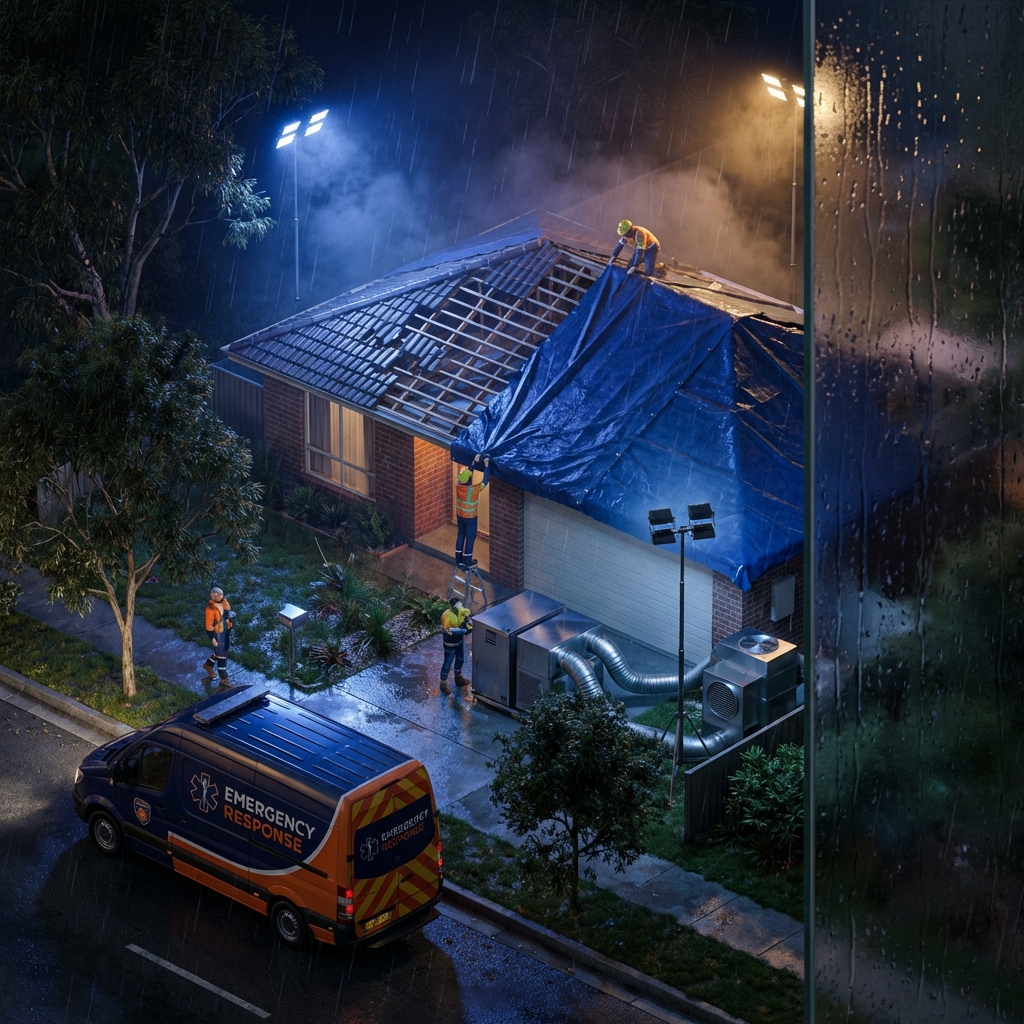
An emergency make-safe is defined by the Insurance Council of Australia (ICA) as “immediate rectification works to prevent further damage to your property or make the site safe to visit.” It is the critical first response after a disaster event — before full restoration begins.
The ICA advises: “Speak to your insurer before authorising any building work, including emergency repairs.” However, when immediate action is required to prevent escalating damage, policyholders have a common law duty to mitigate loss — supported by the Insurance Contracts Act 1984 (Cth) s13 (duty of utmost good faith).
Typical emergency make-safe activities include:
- Roof tarping — temporary waterproof covers to prevent further water ingress
- Board-up services — securing broken windows, doors, and structural openings
- Emergency water extraction — removing standing water to prevent mould and structural damage
- Utility shut-off — isolating gas, electricity, and water to eliminate safety hazards
- Debris containment — clearing hazardous materials from access routes
- Temporary power and lighting — enabling safe inspection and documentation
The IICRC S500:2025 standard (5th Edition, 2021) documents that water damage escalates from Category 1 (clean water) to Category 2 (grey water) within 24–48 hours if left untreated. This escalation window — often misquoted as a “mandatory response deadline” — actually refers to the contamination degradation timeline, not a regulatory requirement. Regardless, the science is clear: faster response means lower cost and less damage.
The $2,750 Emergency Service — What You Get
Disaster Recovery provides a $2,750 initial emergency make-safe service covering the immediate mitigation response required to stabilise your property after a disaster event. This is the first step — not the total restoration cost.
The $2,750 covers the emergency attendance and initial make-safe scope. A compliant invoice is issued specifically designed for insurance reimbursement, with all fields required by major Australian insurers pre-populated.
What the $2,750 emergency service includes:
- 24/7 emergency dispatch — IICRC-certified technician deployed to your property
- Initial damage assessment — documented with photos, moisture readings, and scope notes
- Emergency water extraction — industrial-grade pumps and extractors for standing water
- Temporary weatherproofing — tarping, boarding, and sealing to prevent further damage
- Utility isolation — safe shut-off of compromised gas, water, or electrical services
- Hazard containment — immediate containment of biohazards, asbestos debris, or chemical spills
- Insurance-compliant documentation — photos, readings, and initial scope for claim lodgement
- Compliant $2,750 tax invoice — formatted for direct insurance reimbursement
Additional restoration costs (full drying, mould remediation, structural repairs, contents restoration) are scoped and quoted separately once the initial emergency mitigation is complete. These subsequent works follow the standard insurance scope-and-approval process.
How Insurance Reimbursement Works

Standard Australian home and commercial insurance policies cover reasonable emergency costs incurred to prevent escalating loss. This principle is grounded in the Insurance Contracts Act 1984 (Cth) s13 — the duty of utmost good faith — and the common law duty to mitigate.
The reimbursement process for Disaster Recovery's $2,750 emergency make-safe follows these steps:
- Emergency occurs — Storm, flood, fire, or other insured event damages your property.
- Disaster Recovery attends and performs make-safe — IICRC-certified technician dispatched, emergency works completed, site stabilised.
- Client receives compliant $2,750 invoice — Tax invoice includes all fields required by insurers: ABN, scope of works, site address, event description, and cost breakdown.
- Client lodges invoice with insurer — Submit as part of your insurance claim along with photos, the Authority to Commence, and your policy number.
- Insurer reimburses as part of claim — The emergency make-safe cost is assessed as part of your overall claim settlement.
Key GICOP timeframes: Under the General Insurance Code of Practice 2020, insurers must respond to claims within 10 business days of receipt (Para 68), provide an initial response within 10 business days of receiving all required information (Para 76), and make an overall decision within 4 months (Para 77) for non-catastrophe events.
Important: The $2,750 is paid upfront to Disaster Recovery to commence emergency works. While most policies cover reasonable emergency mitigation costs, the ICA advises speaking to your insurer before authorising building work where possible. The compliant invoice is specifically formatted to support reimbursement through the standard claims process.
The Authority to Commence Form

The Authority to Commence is the legal document that binds the contract between you and Disaster Recovery, and provides the structured documentation that insurers require for claim processing. Every field has been designed to align with insurer expectations.
| Required Field | Why Insurers Need It |
|---|---|
| Site Address | Confirms the insured property location matches the policy |
| Client Details | Matches the policyholder identity for claim validation |
| Description of the Event | Aligns with the claim lodgement details and event type |
| Date of Incidence | Establishes timeline for policy trigger and response window |
| Initial Inspection Report | Provides contemporaneous evidence of damage scope at attendance |
| Scope of Works | Defines exactly what emergency works will be performed |
| Cost Estimate | Substantiates the reimbursement amount ($2,750 emergency service) |
| Disclaimer (re: unseen works) | Protects both parties if hidden damage is discovered during works |
| Business Details | Verifies contractor credentials, ABN, licensing, and insurance |
| Terms and Conditions | Establishes the legal framework for the engagement |
| Signatures (Business + Client) | Legal binding of agreement — required for claim documentation |
This form is completed on-site during the initial attendance. A digital copy is provided to you for your records and for submission to your insurer alongside the compliant invoice.
Your Right to Choose a Contractor
One of the most commonly misunderstood aspects of insurance claims is your right to choose your own contractor. Here is the accurate legal position:
The GICOP 2020 does not explicitly grant a “right to choose your own repairer.” Under Part 4 (Paras 35–41 — Service Supplier Standards), insurers typically appoint their own contractors to manage repairs. However, policyholders have several pathways to engage their preferred contractor:
- Cash settlement (GICOP Para 79) — You can request a cash settlement from your insurer and use those funds to engage your own contractor. The insurer pays you the assessed repair amount, and you manage the restoration independently.
- AFCA complaint pathway — If the insurer's appointed builder cannot meet your needs (e.g., unacceptable delays, quality concerns), you can raise a complaint with the Australian Financial Complaints Authority (AFCA). AFCA recognises the right to choose a contractor when the insurer's panel cannot deliver.
- Nominate a preferred contractor — You can nominate a preferred contractor who meets the insurer's professional criteria (licensing, insurance, IICRC certification). Many insurers will consider this, particularly if the contractor is part of a recognised network.
Historical precedent: The ACCC's 2005 investigation into IAG established the “choice of repairer” principle in motor vehicle insurance, which has influenced broader insurance practice — though it is not directly codified in the GICOP for property claims.
New Zealand comparison: Under the ICNZ Fair Insurance Code 2020 (current version — note: some sources incorrectly cite a 2024 version), the insurer may approve repairs, appoint a repairer, or offer a cash settlement. The insured is required to “take reasonable steps to reduce additional damage” — similar to Australia's common law duty to mitigate.
Key takeaway: While you cannot simply demand your own contractor, you have legitimate pathways through cash settlement (Para 79) or AFCA if the insurer's panel does not meet your needs. NRPG network contractors meet the professional criteria most insurers require.
Why NRPG Contractors vs Standard TPAs
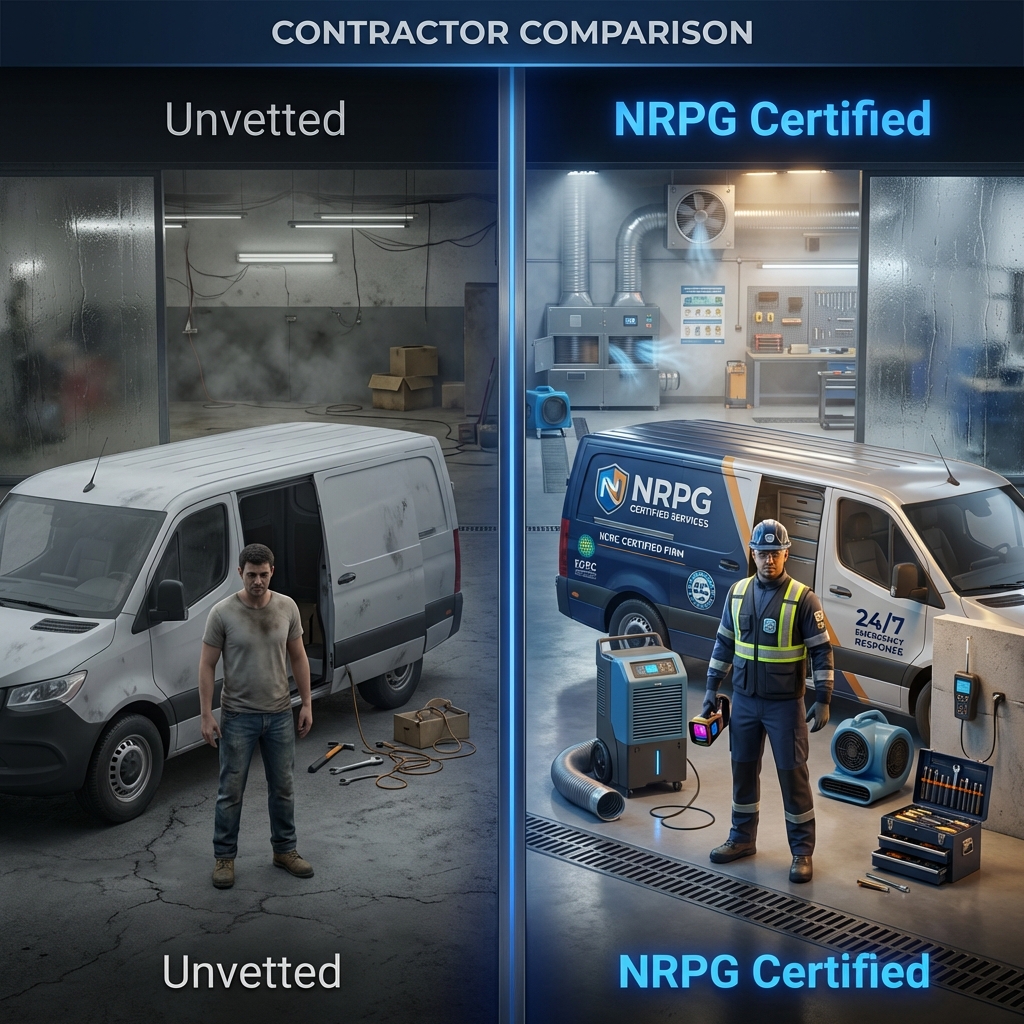
Not all contractors are equal. The General Insurance Code of Practice 2020 (Para 38) requires insurers to verify that their service suppliers have “appropriate qualifications, training and expertise.” NRPG network contractors exceed these minimum standards.
| Factor | Standard TPA / Builder | NRPG Network Contractor |
|---|---|---|
| IICRC Certification | Often uncertified — estimated 70% of AU contractors lack IICRC | Mandatory — WRT, AMRT, FSRT as required |
| Vetting Standards | Varies by insurer panel | National vetting: licensing, insurance, certification, track record |
| Digital Scoping | Often manual/handwritten | RestoreAssist digital platform — standardised, transparent |
| Insurance Compliance | Basic invoicing | Pre-formatted compliant documentation designed for insurer acceptance |
| Training | Ad hoc, often expired | CARSI-delivered IICRC-accredited programs, continuously updated |
| National Coverage | Typically single metro area | Australia-wide — from Coober Pedy to Sydney CBD |
| Documentation Quality | Inconsistent — often insufficient for disputed claims | Standardised: photos, moisture readings, thermal imaging, drying logs |
Frequently Asked Questions
Can my insurer force me to use their repairer?
Insurers can appoint their own contractors under GICOP Part 4, and they can refuse to cover costs above their assessed amount if you use an independent contractor. However, they cannot force you to accept a specific repairer. The pathway is to request a cash settlement (GICOP Para 79) and engage your own contractor. If the insurer's appointed contractor cannot meet your needs (e.g., unacceptable delays), you can escalate to AFCA.
How do I claim my $2,750 emergency make-safe invoice?
Lodge the compliant tax invoice with your insurer as part of your insurance claim. Include the Authority to Commence, event photos, and your policy number. The invoice is specifically formatted with all fields insurers require for processing emergency mitigation costs. Most standard policies cover reasonable emergency expenses incurred to prevent escalating damage.
What if the damage is worse than expected?
The Authority to Commence includes a disclaimer for unseen works — protecting both you and the contractor if hidden damage (e.g., mould behind walls, structural compromise under floors) is discovered during the make-safe. Additional restoration costs are scoped and quoted separately, following the standard insurance approval process.
Is the $2,750 the total cost?
No. The $2,750 covers the emergency make-safe only — the immediate stabilisation and mitigation response. Full restoration (structural drying, mould remediation, rebuilding, contents restoration) is scoped and quoted separately once the initial emergency is resolved. Think of it as the emergency department visit before the specialist treatment plan.
Do I need to pay the $2,750 upfront?
Yes. Disaster Recovery requires the initial $2,750 payment to commence emergency works. Unlike insurer-appointed contractors who may take days to gain approval, we attend immediately. The trade-off is speed: Disaster Recovery can be on-site within the hour without waiting for insurer approval, and the compliant invoice is designed for straightforward reimbursement through your claim.
What does the General Insurance Code of Practice say?
The GICOP 2020 sets key claims handling timeframes: Para 68 — insurers must respond to claims within 10 business days of receipt. Para 70 — insurers must provide updates at least every 20 business days. Para 76 — once all information is received, insurers must decide within 10 business days. Para 77 — overall decision must be made within 4 months (12 months for catastrophe events).
Regulatory References & Sources
Every claim in this guide is supported by verifiable sources. The following references are provided for your own research and to support any insurance discussions:
- General Insurance Code of Practice 2020
Code Governance Committee (CGC) — insurancecode.org.au - Insurance Contracts Act 1984 (Cth)
Federal Register of Legislation — austlii.edu.au - ICA — Frequently Asked Questions After a Disaster
Insurance Council of Australia — insurancecouncil.com.au - AFCA — Home Insurance Claim Delays Factsheet
Australian Financial Complaints Authority — afca.org.au - NZ Fair Insurance Code 2020
Insurance Council of New Zealand — icnz.org.nz - IICRC S500:2025 — Standard for Professional Water Damage Restoration
Institute of Inspection, Cleaning and Restoration Certification — iicrc.org - Moneysmart (ASIC) — How to Make a Home Insurance Claim
Australian Securities & Investments Commission — moneysmart.gov.au
Note: The Australian Consumer Law (ACL) does not directly apply to insurance contracts. Insurance is regulated under the ASIC Act and the Insurance Contracts Act 1984 (Cth). References to “consumer rights” in the insurance context refer to these specific regulatory frameworks, not the ACL.
You May Also Need
Related services and resources for your situation
Emergency Make-Safe Guide$2,750 emergency service, insurance reimbursement, and your right to choose a contractor.Is It Covered?Check if your damage type is typically covered by Australian insurance policies.Insurance DecoderDecode your insurance policy jargon and understand your coverage.Government FundingAustralian government disaster recovery grants and funding programs.Cost EstimatorInstant cost estimate with insurance coverage likelihood for any damage type.Cost GuidesTransparent restoration costs across Australian cities.
Need Help? Get Started Now
$2,750 initial service with insurance-compliant invoicing for reimbursement
Request Emergency Service